I'm studying for the foundation degree in horticulture at Bicton College in Devon. This blog is to record what we do during the course and what I get up to while volunteering at Knightshayes Court near Tiverton one day a week.

Friday, 21 May 2010

Spring in full swing

Things look a little different now to a few months ago. The trefoil beds are starting to come into flower, the terraces are bursting with green and the woods are full of azaleas, rhododendrons and trees finally in leaf.

The new ornamental gardener has started this week, and hasn't yet run screaming from the grounds, vowing never to return. Which is good. She's called Emma and is from Derbyshire, and is a thoroughly nice lass – it felt like she'd been there for ages even though she only started on Monday. We had a chat about how we both ended up where we are now - turns out she's worked at Hardwick Hall up near Sheff; I said I'd jump at the chance to work at Wentworth Castle and she agreed. Her background is training at Trentham and it was really interesting to hear how the gardens there have been completely restored/redone in just the past ten years.

Today's tasks involved continuing the clear-out of the rhododendron beds near the magnolias in Hollies wood. Apparently lots of R. ponticum has been cleared and the intention is to clear the remaining rhodos at the front to create more space to plant more interesting stuff - there are already a few choice acers in there at the back, but they're hidden at the moment. There was a dead Sorbus with a nasty lean, so Dave set about taking down some branches; unfortunately Richard got a bit keen pulling them down and managed to make one fall on Phil's head, giving him a nasty gash. He seemed unfazed but an accident report was filled in all the same.

We finished a bit earlier than usual so I went for a walk around the grounds with my camera - still only one or two peonies out but hopefully next week will have a few more in flower, especially with the heat forecast. Emma said it's supposed to be hot from now until September. Fingers crossed!


Monday, 17 May 2010

Update after a few weeks off

4/5/2010
There were loads of us today so we were divvied up into different areas and I was put in the conservatory and tasked with doing a bit of mulching to keep water in the soil. There was a particularly vicious plant that caught my leg every time I tried to get past it, so I was relieved when the mulch ran out. Afterwards Lucy and I filled up the phormium planters at each end of the lawn with more mulch, and then in the afternoon we headed back to the sloping areas we'd been working on a fortnight ago to keep on weeding. The beds are full of Acer seedlings so Andrew and I are planning to pot a few up and see how they turn out. Unfortunately the beds are also full of Phytophthera and so most of the conifers were struggling or dead. A climbing hydrangea was doing well, scrambling along the bed rather than climbing, so we cleared it of dead leaves and ivy. My fear of ticks hasn't gone away - apparently the trees down there are full of them so I debated wearing some sort of protective armour or tucking EVERYTHING in where possible.

11/5/2010
Today reminded me of what a great invention insect repellent is. The midges were out in force in the woods during the afternoon, making the work almost unbearable. We were working in the top woods, near the magnolias we mulched earlier this year, but this time we were de-weeding around Rhododendrons. Creeping buttercup was the main target, but there was plenty of hairy bittercress, plantain, wild strawberries and sticky stuff (my name, I know it goes under plenty of other names depending on the region) too.

Earlier in the day I'd started off in the conservatory, weeding and sorting out a corner with a particularly rampant vine. We weren't sure what the vine was but it has red tubular flowers with yellow tips, and the leaves and stems smell of vinegar when broken (as happened often - it's not a tough plant). They were crowding out a strelitzia that was also being slowly overtaken by self-seeded Geranium maderense, so we pulled them out and cut back the dead strelitzia leaves; hopefully it'll recover now it has some air and light. There was evidence of vine weevil grubs everywhere - echiums came up with little effort and revealed half-chewed roots and bases; most were growing new roots however so we put them back where we'd found them.

Wednesday, 21 April 2010

Knightshayes comes alive*

*(With apologies to Peter Frampton)

20/4/10 - 7 hours
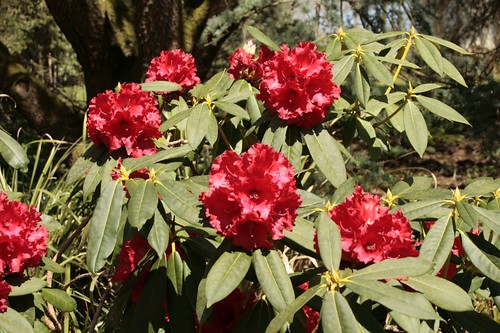
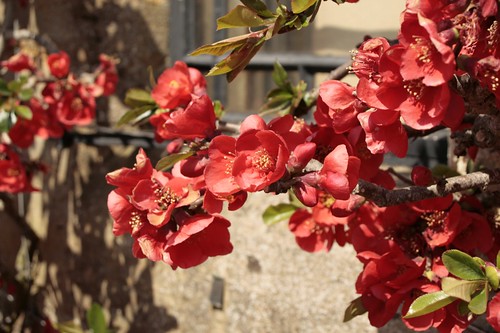
I'm back at Knightshayes after a fortnight's break over the Easter holidays, and what a difference those two weeks have made. Before I went away the weather was atrocious and very little was out in the gardens, although some plants were hinting at things to come. But today the Church Path was a cacophony of colour, with azaleas, rhododendrons, scillas, wood anemones and many others all vying for visitors' attention. And there were plenty of visitors too, with plenty of questions being fired at us. Azaleas and rhodos off Church PathI must have an approachable face because several visitors grabbed me to ask questions - the most popular one being how many people work in the gardens - a difficult one to answer at the moment, although apparently they have found a replacement for Paul (who left last Friday) and a new head gardener too. Change is afoot...

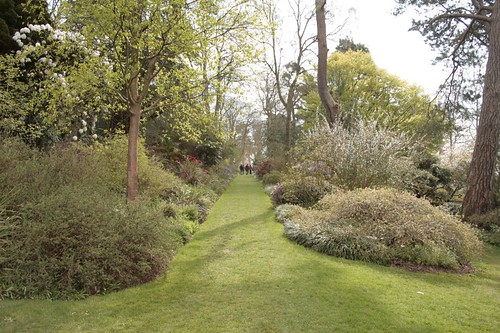
It was a beautiful scene in the gardens today, the sun shining down through the trees. I walked down to the shed with Claire, the newest volunteer, meeting Dave on the way down, who told us to grab trowels and hand forks and head for Church Path for some weeding. We met Jude and Lucy and headed off to find our patch, which was off to the right of the lawn at the end of Church Path.

The bed was in a sorry state, riddled with Phytophthora and hence many of the plants (mostly conifers) looked rather poorly, if not outright dead. A group of Mahonia fortunei had only two survivors as the others had been infected and died. Kaye thought it would probably best to propagate those conifers still showing signs of life and to then strip the bed clear of plants (except several Acers that seemed unaffected), mulch it and then replant with the propagated plants. The bed is also pretty dry because of the large trees nearby (and of course the recent run of sunny weather), making conditions less than ideal.

We weeded among the few plants that had survived, leaving in some lovely dark-leaved violets and a few other low-growing plants. It was hot and thirsty work as the trees' leaves haven't yet opened out, and so there was no sunbreak.

On the way up to lunch I took lots of photos of everything that's coming out, all of which are here. Here are some of my favourites:


Thursday, 8 April 2010

London horticultural findings

Over the Easter weekend I went up to London to catch up with old friends and have a bit of time away from everything. On Sunday I met up with a bunch of folks at Kew Gardens, one of my favourite places in London. Being Easter Sunday, it was overrun with three-wheeler buggies and London's yummiest mummies, but we managed to escape all that by wandering around the bits furthest away from the main entrance, including some bits I'd not been to before.

I can still remember my first trip to Kew, aged 6 or so, although all I recall is the giant pagoda and me thinking it was really big (it still is). This time, however, things have changed a bit, although I am still a big kid and couldn't wait to have a go on the Rhizotron treetop walkway. As soon as I got up there, however, I'm afraid I went round pretty fast, as the walkway has an unnerving habit of moving in strong winds, of which there were no shortage today. Clinging on to the barriers, I peered over the side a few times but after a minor freakout I decided it was time to wander back down. I felt pretty proud of myself, especially as a few folks obviously got halfway up and then froze with fear. It was well worth the view, though I should think it's even better when the surrounding trees are in leaf.

We were disappointed by the waterlily lake (no waterlilies, obv the wrong time of year) and so headed over the lake via the Sackler bridge. I was quizzed on various horticultural things and managed to give some convincing (yet likely bobbins) answers, but was stumped (pardon the awful pun) when Daniel and Justin asked what level of classification a tree is in. They seemed to be under the impression that trees were a higher order, whereas I was trying to explain that a single genus could have trees, shrubs and herbaceous plants in it - trees are not an order in themselves. I wasn't very convinced by my answer, and nor were they.

After a spot of lunch (cake) we went round the glasshouses (brilliant) and the alpine house (brilliant) before a final trip to the waterlily house (again, no waterlilies) and the evolution house (not impressed). The alpine house was particularly great, with many things in full flower and beautifully displayed in pots and among rocks. In the Princess of Wales glasshouse the orchid displays were at maximum impact, and Charlie was amazed by the enormous catfish in the ponds.

On Monday I decided to have a wander round the Barbican, simply because it's one of my favourite places in London, on the off-chance that the conservatory was open. My luck was in, and after an aborted attempt to see the zebra finches playing guitar at the Curve Gallery (queue massive and static) I went up to the top floor and into this little bit of eden among the skyscrapers.

The conservatory is maintained by just two or three staff, but it's a big area with lots of tropical and sub-tropical plants crammed in according to their country of origin. They'd obviously just been watering, and as the sun was out it was hot and steamy. I have to assume that very few people know about this little oasis, as even on a bank holiday Monday it was almost empty - all the better to linger and enjoy the plants. On the upper level there is a dry room for cacti and succulents and orchids, again stuffed with as many plants as there is space for. I had to negotiate giant money trees, hanging baskets of Sedum morganianum and orchids in full flower to see everything on display, but it's well worth a visit. Sadly the photo on the left (taken with my rubbish phone camera) doesn't do it even anything approaching the justice it deserves!

Back outside the Barbican, I had a wander round the highwalks looking out over the gardens. It's all still fairly wintry, with little going on in residents' window boxes - those unfamiliar with the estate would have no idea that it's like the hanging gardens of Babylon in July. I then headed down to my old stamping ground around St Paul's, before passing by the Inner Temple gardens to see if they were open. Sadly they weren't, but I still managed a look through the gate before having a quick scoot around the Middle Temple and the lovely garden square there.

Things are awakening

30/3/10 (I didn't go up on 23/3)

Thick grey cloud hung over the Exe Valley as I drove up this morning, with the forecast promising yet more of the almost incessant rain we've been having this week. The cloud followed me all the way to Tiverton, and shortly after we all walked up to the magnolias to begin mulching, the heavens properly opened and dumped their load. We worked in it for a while but eventually had to retire to the Cedar House as the ground was so waterlogged we were doing more harm than good. We were covering the magnolias' bases with a different sort of mulch that was more like soil than anything else, and it was heavy going, especially with the added rainwater. We were all glad when breaktime came.

The magnolias (all Magnolia campbellii and cultivars) are all in bloom and looking incredible. Two have particularly dark pink flowers, which contrasted beautifully with the looming dark rainclouds behind. More rain followed, we took shelter again, and then when it cleared we moved over to mulch the aforementioned Hamamelis 'Pallida' and a smaller magnolia nearby, M. loebneri 'Leonard Messell', which is just about to flower. It's a shame I won't be there next week, as I'll probably miss quite a lot of the spring flowers.

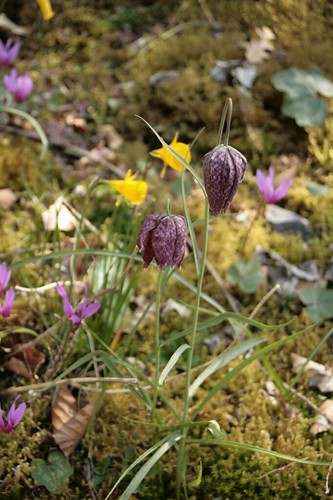
That said, the snake's head fritillaries (Fritillaria meleagris) are beginning to flower on the slopes that have been so wonderfully full of Narcissus cyclamineus to date (they're still going strong). I've been holding on for the fritillaries and was finally rewarded for my wait today. Hopefully they will still be flowering in a fortnight's time when I'm back. The special Knightshayes dogtooth violets (Erythronium revolutum 'Knightshayes Pink' are also beginning to flower in the woodland, though they'll probably be in full swing next week too.

It really feels like spring is coming now, although it's still not quite here. I'm longing for the beech trees to come into leaf, as that's my favourite sight in springtime - lots of fresh, bright green leaves. Here's hoping the arboretum at Bicton has a few.

6.5 hours (had to leave early to finish landscape project)

Thursday, 18 March 2010

Two weeks in one

My college assignments have been relentless and so I'm afraid last week's post fell by the wayside. I'll attempt to remember what we did but it's probably been replaced with sheep prices or suchlike.

Tuesday 9/3/10
With the sun shining down, we started with sorting out a few tired-looking phormiums - chopping down old/dead leaves and clearing out other leaves that had become wedged in and underneath them. No small task, with considerable risk of losing an eye to a particularly vicious leaf spike. My secateurs were hopelessly blunt, as were the loppers, so I had to borrow someone else's to try to chop out the dead leaves. Old, rotten phormium leaves do not want to be cut. It's easy to see why the leaves were used for ropemaking... By this point the sun was shining down, with very little wind, and we all stripped off down to jeans and t-shirts - the first time this year!

Once renewed, the plants looked much better, and we continued with clearing leaves from nearby astelias and from the beds behind the phormiums. We uncovered large numbers of bulbs, including naturalised erythroniums, which Knightshayes is famous for. The bulbs' leaves were all pale from being hidden under leaf mould, but they should get going properly now. After lunch we tackled what we thought was the last lot of hydrangea pruning, but others appeared like triffids on the way back to the shed.

I gave Kay a lift down to the train station on the way home, and we had a very interesting chat. Her partner is the new head gardener at Overbeck's down in Salcombe, and they've both worked for the trust for 10 or so years. Both are career changers, however, which gives me great hope for the future, as they've held pretty senior roles. Kay was very complimentary about me, saying I could have gone for Paul's job (ha! ha! ha!) but that a lot of NT gardeners get in on the basis of enthusiasm rather than formal qualifications or masses of experience, which is encouraging. Hopefully my placement at Knightshayes will count for something in the future.

7.5 hours

16/3/10
Things are starting to get moving. The house and gardens reopened at the weekend, and so now is the time to sort everything out before it gets too busy. Our first task today was to clear out the area next to the gardeners' mess, which has become a general dumping area for everything that doesn't have a home anywhere else. It was prompted by a request from the nursery department to return all the air pots that had been acquired over the last year or so. In with the air pots were piles of plastic plant pots, the old statue covers, lots of random buckets of gravel and compost, plenty of bubble wrap and myriad other things besides. The plastic pots were all set to go to landfill, so I rescued them for my dad and for college (and anyone else who'd take them - there are hundreds), along with a load of bubblewrap (good for frostproofing?). The old statue covers revealed a few overwintering hornets, so we were lucky we didn't get stung.

Once the shed was cleared I was tasked with arranging hydrangea plants into transportable groups, making sure that they all stayed grouped by cultivar, as apparently it is nigh on impossible to tell them apart until they flower, at which point the difference can be embarrasingly obvious. I'm not much of a fan of the old-fashioned hydrangeas, but I'm partial to the odd white lacecap.

With an hour or so until lunch, we headed up to St John's to do some leafblowing, although I was tasked with finishing off the pruning of the aforementioned sly hydrangeas. Just downwind of the beautiful 'Pallida' witchhazel, it was a nice spot, although the bloody hydrangeas had got so overgrown that I was rapidly assimilated and got slapped in the face by last year's flowers on several occasions. I do wonder if I caused a couple of heart attacks in nearby visitors when I emerged from the undergrowth for lunch, hair everywhere and brandishing a pruning saw.

In the afternoon Kay and I decided to get on with righting a Cupressus sempervirens that had grown too big for its stake and which was growing along the ground (presumably from the weight of snow). I quickly discovered that the topsoil in that area is very shallow, and you hit stones very quickly. Thankfully Dave, Patrick and Richard were on hand to help bash the stake in with the help of a very large stump thumper (or whatever they're called), and hopefully the cupressus will be a bit happier now.

Patrick had his interview for the seasonal gardener position in the kitchen garden, so we're keeping our fingers crossed. However the other shortlisted applicants were two people who'd been made redundant from the BBC's Berryfields garden, so he's up against some strong competition. I think he's got a good chance though, as Lorraine, the area supervisor, thinks he's great.

I've been borrowing books from the garden office - they have a nice selection of pretty specialist books on a range of hortic subjects, so last week I borrowed some on shrubs, and this week some herbaceous border books, all to research my design for the Commodore's Garden in Dartmouth.

7 hours
Tuesday, 2 March 2010

National Trust strategy and fighter jets

Today was Knightshayes' pre-season meeting, but before that got under way we managed a fair bit of rose pruning (yes, again) - this time the rose in question was alive, which is better (or not, depending on your view of roses). I still don't have the knack of pruning and should probably read up on it, as I've either gone mad and reduced the poor plant down to a shadow of its former self, or it looks like I've not been near it. I get the whole reducing it by a third thing, that's fine, but it's the bits to reduce (outward facing buds? Old branches? Dead bits?) that are confusing. I have come to the conclusion that it's a dark art known to and practised by the chosen few, of which I am not one.

The purpose of the pre-season meeting is to apprise everyone of how the previous year went, and what plans the various managers have for the coming year. First we heard from John Longworth-Krafft, assistant director of operations for the south-west region, on how the Trust is aiming for a more local approach, both externally and internally - leadership and delegation (ie giving staff more direct responsibility) were the buzzwords there. There was also a fair bit of emphasis on taking risks and not being as rigid an organisation as has been the case in the past. Then we heard from various Knightshayes supervisors and staff members on their particular department. 2009 was a record year for Knightshayes in several ways, with more than 112,000 visitors, and budgets met and exceeded.

After lunch Lucy and I headed back into the woods to do some cutting back and clearing while the blokes went about putting manure down. On the way we were treated to a low-flying buzzard with what looked like a fish from the pond in its talons. We chopped back the remaining epimediums and cleared old leaves from around the aforementioned rose, though the job was made much harder by what looked like variegated nettle runners, which wove through everything and made gathering the leaves doubly difficult. This was soundtracked by the whoosh of fighter jets heading over the hills; on their return journey they seemed little higher than the treetops, which was rather unnerving, especially for the resident birds.

The spring plants are really going for it now - swathes of snowdrops and crocuses are round every corner, and the hellebores are in full swing too. A white azalea was covered in flowers, and the winter aconites are peeping out of the manure too. The camellias continue to brighten up various corners with flowers in various shades of white and red, and the sound of birdsong is everywhere during the morning, with one bird doing a passable impression of a car alarm...

7.5 hours